The Reason I Have an Opinion on This (And Why It Cost Me $300)
The first time I failed the CCNA, I had taken hundreds of practice questions. Seriously. I had a spreadsheet tracking my scores. I was averaging 78% across three different free sites and feeling pretty good about my chances.
I walked out of the testing center with a 791. Passing is 825.
The thing I had to accept afterward: not all practice exams are the same. Some actually prepare you for the test. Some just make you feel prepared. Those are very different things, and I learned the hard way which category mine fell into.
Since then, I’ve passed the CCNA, earned my CCNP Enterprise, and used or evaluated every major CCNA practice exam product out there. This ranking is based on that experience, not affiliate deals or marketing copy, just what actually works when you’re sitting in that testing center chair.
(Spoiler: one product is in a completely different tier than everything else. You probably already know which one.)
What Makes a CCNA Practice Exam Actually Good?
Before the rankings, it’s worth being clear about what we’re judging. A good CCNA practice exam has to do three things well.
First, it has to ask questions at the right difficulty level. The real 200-301 is not straightforward. Cisco writes questions that require you to apply concepts, not just recall them. If a practice exam feels easy, that’s a red flag, not a green one.
Second, the explanations have to teach. Getting the answer is almost beside the point. Understanding why the other three options are wrong, and in what scenario they’d actually be right, is what builds the knowledge you need. Short explanations that just restate the correct answer are nearly useless.
Third, the question pool has to be large and varied enough that you’re learning patterns rather than memorizing specific questions. If you can recognize questions from having seen them before, you’re not studying anymore. You’re rehearsing.
With that in mind, here’s the ranking.
The Rankings
#1 — Boson ExamSim ($99 / $149 with NetSim)
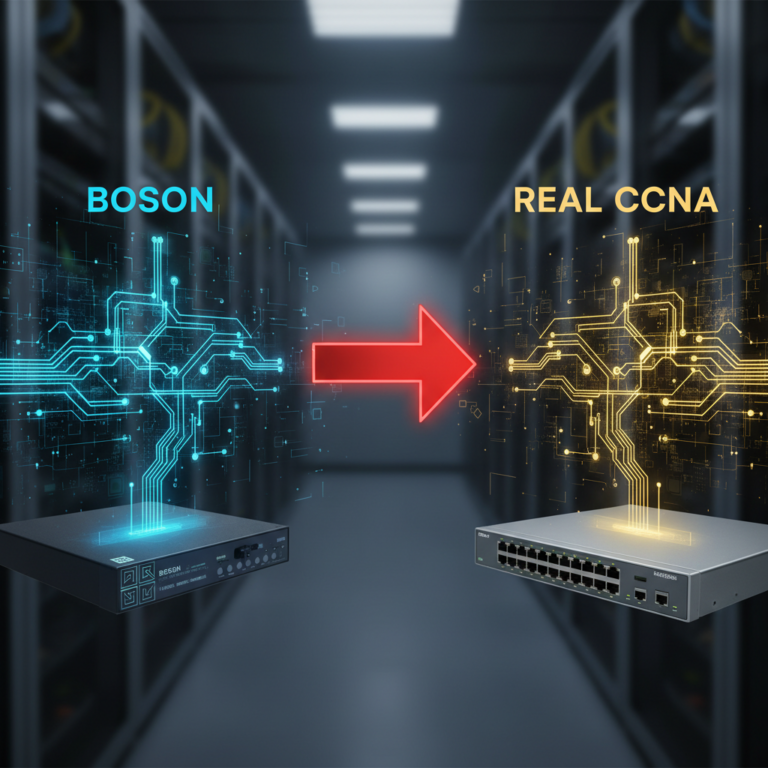
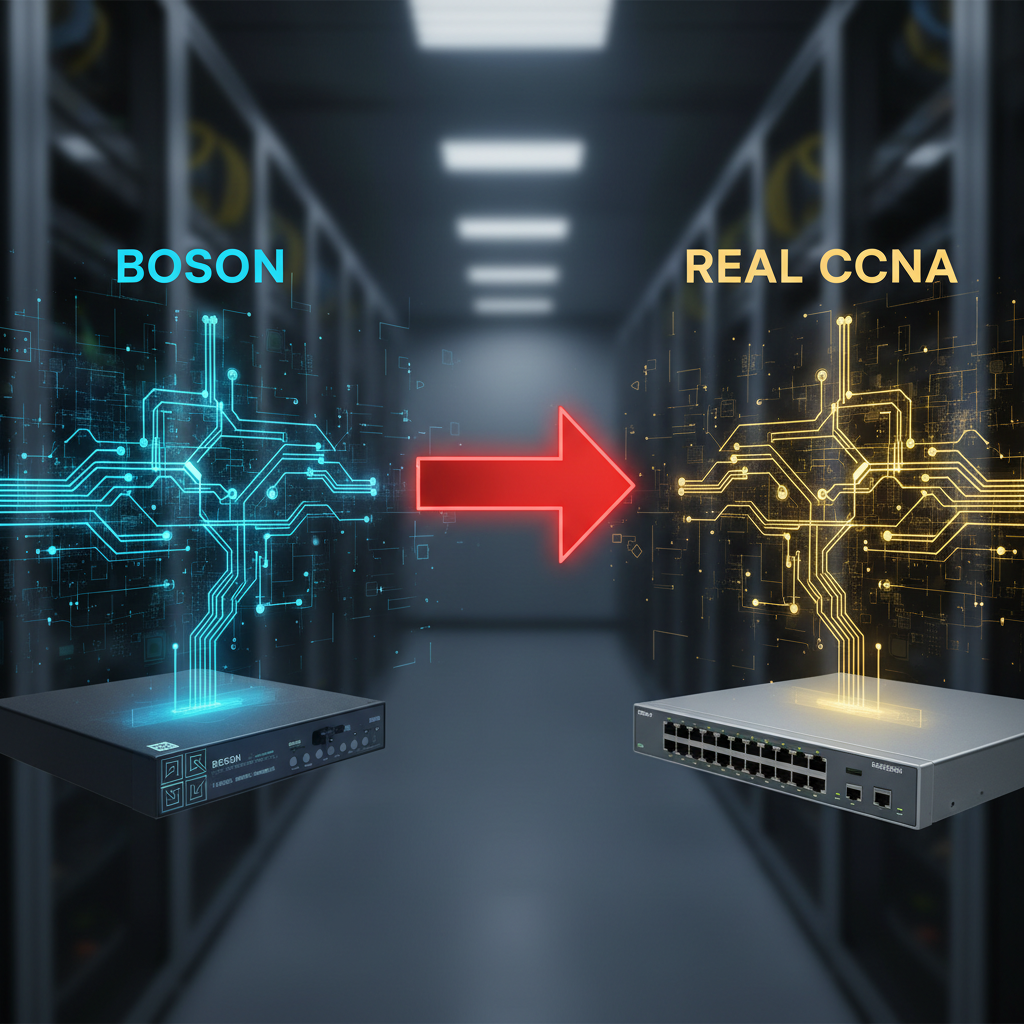
There is no close second. I want to say that upfront because I know it sounds like marketing, and I’m aware I’m writing this on a site that links to Boson. But the gap between Boson and everything else on this list is not small.
The questions are harder than the real exam. Not in a cheap trick way, but in the way that actually matters. They’re multi-layered. They test whether you understand OSPF adjacency formation well enough to identify three plausible failure causes from a six-option list where two of the wrong answers would be correct in a slightly different scenario. I’m not exaggerating. I have screenshotted those questions.
The thing that separates Boson from everything else is explanation quality. I once spent 45 minutes on the explanation for a single OSPF question. It included a breakdown of adjacency states, why each wrong answer maps to a different failure symptom, troubleshooting commands for the real world, and a note flagging a related question type that appears on the exam. Three pages. For one question.
That’s not a practice exam. That’s a tutor.
The custom exam builder lets you isolate weak topics and drill them specifically. Simulation mode mirrors real exam pressure with a locked timer and no mid-exam answer checking. Score reports break down time-per-question and track improvement by objective over time. The NetSim labs drop you into broken network scenarios and make you figure out what’s wrong, which is about as close to the real job as exam prep gets.
I went from a 540 on my first Boson practice exam to consistently hitting 850+ before I sat for the real test. I finished the actual exam with 20 minutes left and an 875. The full story is in my Boson ExamSim review if you want every detail.
The $99 price tag is the only legitimate complaint, and even that falls apart when you price in a $300 retake fee. The interface also looks like it hasn’t been touched since 2007. Neither of those things matters much when the product works this well.
Best for: Anyone who has their fundamentals down and is in serious exam prep mode.
Not for: Complete beginners. Build your foundation first or Boson will just demoralize you before you’re ready for it.
Where to get it: Boson.com. Watch for 15-20% off around the holidays.
#2 — Cisco U. / Pearson Official Practice Tests (~$50)
The official Cisco/Pearson practice tests are written by the same people who write the actual exam. That’s genuinely valuable, and it’s also their biggest limitation.
The questions are representative of real exam difficulty and structure. The format is familiar, the terminology is precise, and you won’t encounter anything wildly off-topic. For a final calibration check in the last week before your exam, these are genuinely useful.
The weak spot is explanations. They’re thin. You’ll often get the correct answer confirmed without much insight into why the others were wrong. If you miss a question, you may finish reading the explanation and still not fully understand the concept. That’s a problem for a study resource.
Question volume is the other issue. The pool isn’t deep enough to carry you through a multi-week study period. You’ll exhaust meaningful variety faster than you’d like.
Use these as a reality check, not a primary resource. Score consistently above 800 here before you schedule your exam date.
Best for: Final-week calibration alongside a primary prep tool like Boson.
Not for: Standalone study or anyone trying to build deep conceptual understanding.
#3 — Udemy Practice Tests (Jeremy’s IT Lab / Jason Dion) (~$15-25, often $10 on sale)
Udemy has a few practice exam products worth talking about. Jeremy Cioara’s tests and Jason Dion’s sets are the ones most people recommend, and both are better than you’d expect at the price point.
The questions are solid and clearly written by someone who knows networking. Explanations are better than Pearson’s, though not in the same league as Boson. The value per dollar is hard to argue with, especially when Udemy does their routine sales and these drop to $10.
The honest problem is that Udemy tests run easier than the real exam. I scored well into the 80s on Udemy practice sets during the same study cycle where I failed the actual test. They gave me good knowledge of the material, but they also gave me a false sense of how ready I was for Cisco’s specific question style.
These work well as a bridge between initial studying and serious Boson drilling. Just don’t use them as your final readiness benchmark.
Best for: Mid-prep reinforcement, budget-conscious studiers.
Not for: Final exam readiness assessment. The difficulty gap will mislead you.
#4 — MeasureUp (~$99)
MeasureUp positions itself as a premium product and charges accordingly. The question quality is decent and the platform is clean and modern, noticeably easier to use than Boson’s dated interface.
The problem is that at the same price as Boson, decent isn’t good enough. The explanations don’t go as deep. Question difficulty is inconsistent; some are genuinely challenging, others feel closer to Udemy territory. The scenario-based questions, which are the ones that matter most for exam prep, are less developed than what Boson offers.
If Boson didn’t exist, MeasureUp would probably be the easy recommendation at this price point. But Boson exists, and the comparison at $99 is not kind to MeasureUp.
Best for: Learners who find Boson’s interface genuinely unbearable and are willing to trade some depth for a better experience.
Not for: Anyone whose main priority is actually passing the exam.
#5 — ExamCompass / Free Sites (Free)
ExamCompass, Exam-Labs, and similar free sites have a specific place in the study process: the very beginning. If you’re trying to figure out what you know and what you don’t, or you’re not sure yet whether you want to pursue the CCNA, they work fine for that.
For actual exam preparation, they fall short in the same way I described at the top of this article. The questions are simpler. The answer choices are less tricky. The explanations are minimal. Scoring 80% on these sites tells you almost nothing about how you’ll perform on the real exam.
I was averaging 78% on free sites before I failed with a 791. That experience is so common among CCNA candidates that it’s practically a rite of passage.
Use free sites to take inventory of your starting point. Then move to paid resources before you start treating your scores as a readiness signal.
Best for: Early-stage self-assessment, complete beginners, zero-budget situations.
Not for: Realistic exam readiness measurement.
Honorable Mention — CBT Nuggets Practice Questions
CBT Nuggets includes practice questions in their subscription, and they work fine as a companion to the video content, basically a knowledge check after watching a module. As standalone exam prep they’re limited in scope and depth. I covered this in my CBT Nuggets review, but the short version is that their video production quality doesn’t carry over to the practice questions.
How to Actually Use These Together
These products aren’t mutually exclusive. Here’s the approach that worked for me:
Phase 1 (Foundation): Work through your primary study material. OCG, a video course, Packet Tracer labs. Use free sites or Udemy tests as chapter-end knowledge checks. Don’t treat your scores seriously yet.
If specific concepts aren’t clicking during this phase, the CCNA glossary is useful for terminology, and the subnetting guide will save you several hours if subnetting hasn’t clicked yet.
Phase 2 (Serious prep): This is when Boson enters the picture. You should be scoring 70%+ on free sites before you start here. Not because you need that exact number, but because Boson will demolish you if you don’t have a foundation, and getting demoralized that early causes people to quit. Expect your score to drop when you switch over. That’s the point.
Phase 3 (Final calibration): In the last week before your exam, run through the official Pearson/Cisco practice tests. If you’re consistently hitting 800+ on Boson and 800+ on official tests, you’re ready to schedule.
The Bottom Line
Most people who fail the CCNA weren’t underprepared in terms of hours. They were underprepared in terms of preparation quality. Two hundred hours with free practice sites will leave you less ready than a hundred focused hours with Boson, because thinking the way Cisco’s exam requires is something you have to actively build. It doesn’t just happen from volume.
Buy Boson, accept the humbling early scores, trust the process, and schedule your exam when you’re consistently above 850 on their simulations. The tools exist to make this work. Use them.
For the longer version of why I believe this, the full Boson review has my exact study schedule, week-by-week score progression, and the specific features that made the difference.
Stop shopping for the perfect resource and start using the one that works.
Quick Reference: CCNA Practice Exam Rankings
| Product | Price | Difficulty Match | Explanation Quality | Best Use |
|---|---|---|---|---|
| Boson ExamSim | $99 / $149 | Harder than real exam | Exceptional | Primary prep, weeks 4-12 |
| Cisco/Pearson Official | ~$50 | Accurate | Thin | Final-week calibration |
| Udemy (Jeremy / Dion) | $10-25 | Slightly easy | Good | Mid-prep reinforcement |
| MeasureUp | ~$99 | Variable | Moderate | UX-first alternative to Boson |
| Free sites | Free | Too easy | Minimal | Early self-assessment only |

Network Engineer | CCNA | CCNP Enterprise
Allen Viola is a CCNP-certified network engineer who writes about exam prep and networking fundamentals from hard-won personal experience. He failed his first CCNA attempt, rebuilt his study approach from scratch, passed with an 875, and has kept going ever since. Everything he writes comes from that same mindset.