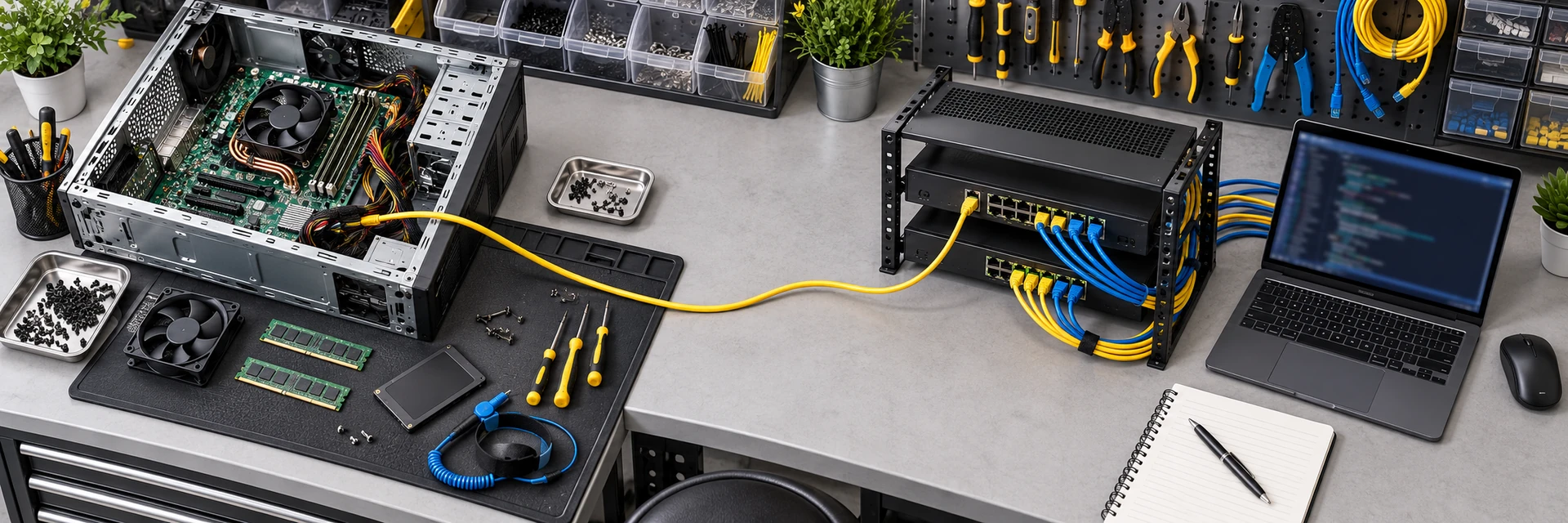
Yes, the CCNA is harder than the A+. Not twice as much material harder. A different kind of harder. The A+ asked me to recognize things. The CCNA asks me to build things, and then asks me to fix them when they break.
I passed both A+ exams last year and I am partway through CCNA study now. This is the honest version of what that jump feels like, written while I am still in it rather than five years after the fact.
Is the CCNA Harder Than the A+?
The A+ is two exams, Core 1 and Core 2, each with its own fee and its own study window. Wide coverage, shallow depth: hardware, operating systems, mobile devices, printers, basic security, a bit of everything a help desk sees.
The CCNA is one exam, 200‑301, 120 minutes, $300, and it goes deep on one subject. It expects you to configure a router from a blank prompt, read a routing table and say which route wins, subnet in your head, and troubleshoot something you did not build.
The difficulty difference is not the page count. It is that A+ questions have a recognizable answer sitting in the options, and CCNA questions often do not. A subnetting question gives you four addresses and no hint about which one is the network address. Either you can do the math or you cannot.
What Actually Carries Over From the A+?
More than I expected.
The A+ networking section covers cable types, common ports, the difference between a switch and a router, IP addressing basics, and wireless standards. All of that reappears in CCNA, just deeper. When Cisco material talks about a straight through cable or the 2.4 and 5 GHz bands, that is A+ content with more detail stacked on top.
The troubleshooting methodology carries over too, and it is underrated. A+ drills the habit of establishing a theory, testing it, and working the layers in order. That habit is exactly what a CCNA lab question rewards. When a link is down, I still start at layer 1, and that came from A+.
What does not carry over is the study method. A+ rewarded flashcards. CCNA punishes them.
What the A+ Never Prepared Me For
The command line. A+ barely touches IOS. CCNA lives there. The first time I had to configure a trunk port, I knew what a trunk was and had no idea how to make one exist. Knowing the concept and knowing the syntax are two separate memories, and only one of them gets tested in a lab question.
Subnetting under time pressure. A+ wants you to know what a subnet mask is. CCNA wants the broadcast address of 192.168.14.64/26 in about forty seconds, with no calculator. That skill takes weeks to build, not an evening.
No going back. Cisco exams move forward only. There is no flag and review pass at the end like there is on CompTIA exams. That changes how you spend your time on a hard question, and it caught me completely off guard the first time someone told me.
The volume of configuration. On the A+, I read and answered. On CCNA, if I am not typing commands I am not studying. That was the biggest adjustment, and the thing I got wrong for my first month.
How Long Does the CCNA Take After the A+?
Longer than the A+ took. Both A+ exams together took me about three months of evenings. For CCNA, people with a similar background usually land somewhere in the four to six month range at eight to ten hours a week, and I am tracking toward the back half of that.
The variable is not intelligence, it is lab hours. Someone reading two hours a night and labbing zero will take longer than someone reading one hour and labbing one. Every CCNA candidate I have talked to who finished fast did the same thing: configured every topic while learning it instead of after. There is a fuller breakdown in how long the CCNA takes to study for, broken out by starting point.
Do You Need the A+ Before the CCNA?
No. The CCNA has no prerequisites, and plenty of people start there.
Whether you should is a different question, and it depends on what you are trying to do next. If you want a help desk or desktop support job in the next few months, A+ gets you interviews faster and costs less per exam. If you already work in IT and want to move toward networking, A+ is a detour and CCNA is the destination.
What A+ gave me was vocabulary. Starting CCNA already knowing what DNS, DHCP, a default gateway, and a VLAN roughly were meant I was learning one new thing at a time instead of five. If you are starting from zero with no IT job at all, that head start is worth something. If you have been fixing networks at work for two years, skip it. Our older comparison of CCNA versus A+ walks through the career side of that choice.
What I Would Do Differently
Three things, in order of how much they cost me.
Lab from week one. I spent the first month reading and watching video, thinking I would start labbing once I understood things. Backwards. The labs are how you understand things. Cisco Packet Tracer is free through Cisco Networking Academy, and the free tier of Cisco Modeling Labs runs the same IOL images the exam uses behind the scenes.
Drill subnetting daily instead of in blocks. Ten questions every morning beats two hours on a Sunday. It is a speed skill, and speed skills come from frequency.
Stop rewatching. I rewatched a VLAN video three times because it felt productive. Typing the commands once taught me more than all three viewings, and my first real lab attempt taking three hours was the most useful three hours in the whole month.
Should You Wait for CCNA v2.0?
Only if you are realistically not ready before February 2027.
Cisco announced blueprint v2.0 in May 2026. The last day to sit the current v1.1 exam is February 2, 2027, and v2.0 starts February 3, 2027. The exam code stays 200‑301 either way, the certification you earn is the same CCNA, and it is good for three years from your pass date regardless of which blueprint you tested on.
For me that math is simple. I am aiming at December, which puts me on v1.1 with a buffer. If I slip past the cutover I will study the new topics and take v2.0, and my study time on subnetting, switching, routing, and OSPF transfers either way. The fundamentals did not change. What changed is how much troubleshooting Cisco expects, and practicing troubleshooting was the right move anyway.
Frequently Asked Questions
Can you pass the CCNA with no IT experience?
People do it, and it takes longer. Expect six months or more of consistent study with heavy lab time rather than the three or four months an experienced admin might need.
Is the A+ a waste of time if I want networking?
Not a waste, but not required. It helps most if you need a job quickly or you are starting with no IT vocabulary at all.
How much does the CCNA cost compared to the A+?
The CCNA exam is $300 for a single attempt, plus tax. A+ is two separate exams, each with its own fee, so the total lands in a similar range but is paid in two pieces.
Does the CCNA expire?
Yes, three years from the day you pass. You renew with continuing education credits or by passing another qualifying exam.
What is the hardest part of the CCNA for a beginner?
For me it is the CLI muscle memory, not the theory. Concepts click during a video. Commands only stick after you have typed them wrong a few times.
If you are sitting on an A+ right now and wondering whether to start, start. The jump is real, but the gap is a study habit gap more than a knowledge gap, and the habit is simple enough to describe: open a lab before you open a book.

IT Help Desk Technician | CCNA Student
I just started my first real IT job and honestly, some days I feel like I have no idea what I'm doing. I'm studying for my CCNA, breaking things in Packet Tracer, and writing about all of it as I go. If you're just getting started too, you're in the right place.