
Most people need three to six months and 200 to 300 hours of real work to pass the Cisco Certified Network Associate (CCNA) exam. If you already do networking for a living, you can land closer to 100 to 150 hours. If you’re coming in cold with no IT background, plan on the top of that range and maybe a little past it. The honest answer is that “how long” depends almost entirely on where you’re starting and how many hours a week you can actually protect.
I passed the 200‑301 on my first try after about four months, studying maybe ten hours a week around a full-time job. That put me on the faster end because I wasn’t starting from zero. The people I’ve watched finish fastest since then weren’t smarter than everyone else. They were just realistic about their schedule and didn’t restart their study plan every two weeks.
One thing that changes the math in 2026: Cisco announced a new exam version. Your timeline now has a deadline attached to it, and I’ll get to why that matters below.
How many study hours does the CCNA actually take?
Budget 200 to 300 hours. That’s the number I keep landing on, both from my own prep and from watching other people go through it, and it lines up with what most study guides quote. It is not 200 hours of watching videos with your brain half off. It’s 200 hours of labbing, drilling subnetting, redoing practice questions, and configuring things until the commands stop feeling foreign.
The range is wide because the current 200-301 v1.1 blueprint covers six domains: network fundamentals, network access, IP connectivity, IP services, security fundamentals, and automation and programmability. That last one carries about 10 percent of the weight and it trips up people who’ve been racking switches for years but never touched Python or JSON. A career switcher and a senior network admin are not studying the same exam, even though they sit for the same test.
How long does the CCNA take based on your experience?
Here’s the breakdown I give people when they ask me to ballpark it. Find the row that sounds most like you and treat the timeline as a starting estimate, not a promise.
| Where you’re starting | Realistic timeline | Hours per week | Total study hours |
|---|---|---|---|
| No IT background at all | 5 to 6 months | 10 to 15 | 250 to 300 |
| Some IT experience (help desk, CompTIA A+ or Network+) | 3 to 4 months | 8 to 12 | 180 to 220 |
| Working network or systems admin | 2 to 3 months | 6 to 10 | 100 to 150 |
| Strong fundamentals, just need the cert | 6 to 10 weeks | 8 to 10 | 80 to 120 |
Notice the total hours don’t swing as hard as the timeline does. Someone with a Network+ background and someone fresh out of a different career might both spend close to 200 hours. The difference is that the beginner needs more calendar time to let the concepts settle, because you can’t cram fundamentals the way you can cram trivia.
What makes the CCNA take longer than people expect?
Subnetting is the big one. I’ve watched people lose a full month to it because they kept memorizing charts instead of understanding the binary underneath. Once it clicks you can do it in your head in seconds, but getting there takes reps. If you’re stuck, I wrote up how I went from binary tears to mental math, and it’s basically the method I wish someone had handed me on day one.
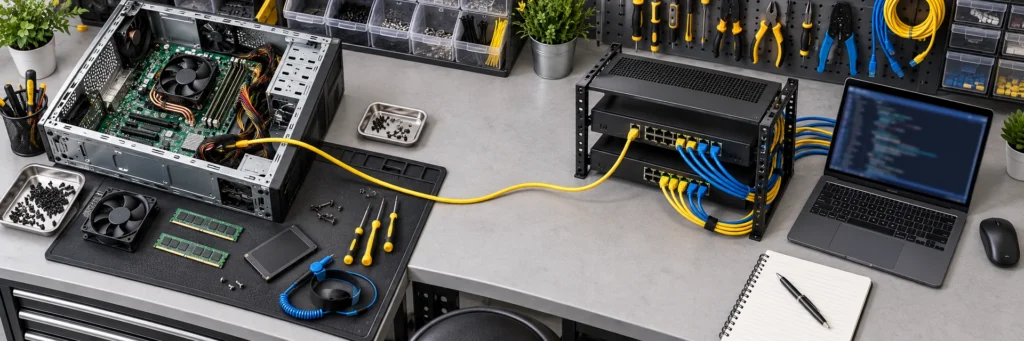
The other time sink is hands-on configuration. You cannot pass this exam by reading alone, because Cisco builds in simulation and lab-style questions that ask you to actually configure or troubleshoot something. If you’ve never typed a command into a router, budget extra weeks for lab time. Free tools like Cisco’s Packet Tracer through the Networking Academy are enough to build the muscle memory.
And then there’s life. The plan that says “two hours a night, five nights a week” looks great on paper and falls apart the first time work gets busy. The people who stall out usually aren’t lazy. They just built a timeline that assumed every week would be a good week.
Does the new CCNA v2.0 change your timeline?
It can, and this is the part almost nobody planning a study schedule right now has factored in. Cisco announced CCNA v2.0 on May 20, 2026. The current v1.1 exam is available until February 2, 2027, and v2.0 goes live February 3, 2027. The exam code stays 200‑301 either way, and a CCNA earned on v1.1 is good for three years, so passing before the cutover costs you nothing.
Here’s how it touches your timeline. Run your estimate from the table above. If your finish date lands comfortably before the end of January 2027, ignore v2.0 and study for the current exam like nothing happened. If your date lands close to February 2027, you have a decision to make, because a rushed v1.1 attempt is worse than a prepared v2.0 attempt. And if you’re starting fresh in the fall of 2026 or later, study for v2.0 from the beginning so you’re not learning a blueprint you’ll never sit.
Whichever version you end up on, the core hours don’t change much. Subnetting, routing, switching, and troubleshooting are still the job. If anything, v2.0 leans harder on troubleshooting, which means more lab time and less pure memorization.
Can you pass the CCNA in 30 days?
Yes, but only if you already know most of the material. I wouldn’t hand a 30-day plan to anyone seeing OSPF, VLANs, or access control lists for the first time. A month is enough to review, drill weak spots, and get exam-ready when the foundation is already there. It is not enough to build that foundation from scratch. OSPF alone eats more time than beginners expect, which is why I broke it down separately in how OSPF works and how to stop failing the questions.
If you’re tempted to rush because the CCNA exam costs $300 plus tax and you want it over with, slow down. A failed first attempt means paying the fee again, plus a five-day wait before you can retake. An extra month of studying is cheaper and less demoralizing than failing and rebuilding your motivation from zero. If it does happen, it isn’t the end of the road, and I’ve written about what actually happens if you fail the CCNA.
What does a realistic study schedule look like?
The version that worked for me, and for most people I’ve talked through it, splits into thirds. Spend the first third on a full video course or the Official Cert Guide, reading and watching to get the lay of the land. Spend the middle third labbing every concept and grinding subnetting until it stops scaring you. Save the final third for practice questions, finding your weak topics, and drilling those specifically.
One thing I’d push hard: don’t wait until the end to start practice questions. Mix them in around the halfway mark so you learn how Cisco phrases things. The concepts are one battle. The wording of the questions is a separate battle, and you want to fight that one before exam day, not on it. A good question bank is worth the money here, and I ranked the ones I’ve actually used in my breakdown of the best CCNA practice exams.
If you’re sitting there wondering whether the whole thing is even doable for you, it almost certainly is. The CCNA is hard, not impossible, and the gap between the two matters. I get into that in is the CCNA too hard for you if you want the longer version.
Frequently asked questions
How many hours a day should I study for the CCNA?
One to two focused hours a day is plenty for most people, especially around a full-time job. Consistency beats marathon sessions. Two solid hours five days a week gets you exam-ready faster than cramming eight hours every Saturday and nothing the rest of the week.
Can I study for the CCNA in two months?
Two months is realistic if you have networking experience or a CompTIA Network+ background. Coming in with no IT foundation, two months will feel like drinking from a fire hose and your odds of passing drop sharply. Be honest about your starting point before you commit to that timeline.
Is the CCNA harder to study for than CompTIA Network+?
Most people find the CCNA tougher. It goes deeper on routing and switching, includes hands-on configuration questions, and is vendor-specific to Cisco. Network+ is a solid stepping stone, and if you’ve passed it, you’ve already covered a chunk of the CCNA fundamentals.
How long is the actual CCNA exam?
The 200-301 exam runs 120 minutes and typically includes 100 to 120 questions, mixing multiple choice, drag-and-drop, and simulation-based items. Time management matters, since the lab questions eat more minutes than the multiple-choice ones.
Do I need to know Python to pass the CCNA?
Not as a programmer. The current v1.1 blueprint includes automation and programmability, so you’ll want to understand basic Python concepts, JSON, and REST APIs at a conceptual level, roughly 10 percent of the exam. Worth noting for anyone planning past February 2027: the incoming v2.0 blueprint trims much of that REST and JSON material, so if you end up on the new exam, this is one area that gets lighter.
What’s the fastest anyone realistically passes the CCNA?
People with years of hands-on networking sometimes pass with three to four weeks of focused review. That’s the exception, not the rule, and it assumes the fundamentals are already there. For most candidates, rushing under three months is where pass rates start to suffer.
Set your date and work backward
Pick the row in that table that matches your real starting point, not the one you wish described you, and build your timeline around the hours you can actually protect each week. Three to six months is the honest range for most people. Then check that date against the February 2, 2027 v1.1 cutover so you know which exam you’re aiming at. The candidates who get there aren’t the ones with the most free time. They’re the ones who picked a plan they could stick to and stopped restarting it. Set your date, work backward, and start labbing this week.
Network Engineer | CCNA | CCNP Enterprise
Allen Viola is a CCNP-certified network engineer who writes about exam prep and networking fundamentals from hard-won personal experience. He failed his first CCNA attempt, rebuilt his study approach from scratch, passed with an 875, and has kept going ever since. Everything he writes comes from that same mindset.