
I’ve been working as a network administrator for almost ten years, and the last few months have felt different. Not bad different. Just different. The job postings I see now don’t look like the ones I applied to back in 2016. The skills my boss is asking me to learn aren’t the same ones I was hired for. And when I talk to other admins at meetups or on Reddit, we’re all noticing the same thing: the job is changing faster than it has in years.
So what’s actually happening to network admin jobs over the next two years? I’m not a labor economist, but I can tell you what I’m seeing in real job postings, what’s changing in my own work, and what my peers are dealing with. This isn’t speculation. It’s pattern recognition from someone who checks job boards more often than she’d like to admit.
The Job Market Numbers: What the Data Actually Says
The Bureau of Labor Statistics projects that network and computer systems administrator jobs will grow by about 3% from 2023 to 2033. That’s slower than average compared to other occupations. But here’s the thing: that number hides more than it reveals.
Traditional network admin roles are shrinking in some sectors. Companies are consolidating positions. They’re moving infrastructure to the cloud and calling it “modernization.” Some of that is real efficiency. Some of it is just cost cutting with a new name. But at the same time, new types of network admin jobs are appearing. SD-WAN specialists. Cloud network engineers. Automation-focused admins. The title “Network Administrator” is splintering into about five different jobs, and the BLS doesn’t break them out separately yet.
I looked at job postings in my region last month. Out of 47 network-related openings, only 12 were titled “Network Administrator.” The rest were “Network Engineer,” “Cloud Infrastructure Engineer,” “DevOps Engineer,” or some hybrid role that wanted networking skills plus three other specialties. The jobs exist. They just don’t always call themselves what we expect.
What’s Changing in Network Admin Work Right Now
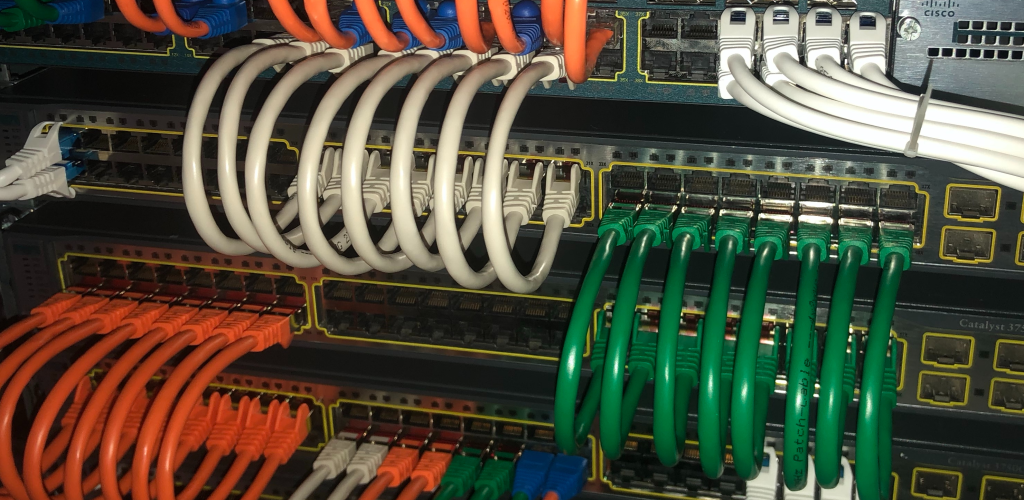
The biggest shift I’m seeing is the move from hardware-focused work to software-focused work. Five years ago, most of my time went into configuring switches and routers, troubleshooting physical connections, and managing VLANs across a dozen sites. I still do that, but it’s maybe 40% of my job now instead of 80%.
The rest of my time goes into managing SD-WAN overlays, writing Python scripts to pull config backups, troubleshooting cloud network peering, and trying to make our firewall policies consistent across three different platforms because we acquired two companies and inherited their infrastructure. The gear is still there. But the job is less about walking to an IDF and more about logging into five different dashboards.
Automation is the other big change. I resisted it for too long. I thought “I can configure a VLAN faster by hand than I can write a script to do it.” That was true for one VLAN. It was not true for 40 VLANs across eight sites. Now I’ve got Ansible playbooks that handle most of our repetitive config work, and honestly, I should have started learning this stuff two years earlier than I did.
Here’s what I’m seeing in job postings for 2026 and 2027: almost every network admin role now lists at least one scripting language as “preferred” or “required.” Python is the most common. Bash and PowerShell show up a lot too. Five years ago, scripting was a nice-to-have for senior engineers. Now it’s baseline for mid-level admins. If you can’t read a Python script and understand what it’s doing to your network, you’re going to struggle in the next round of job hunting.
Cloud Skills Are No Longer Optional
I avoided cloud networking for a long time. I liked physical gear. I liked knowing exactly where a packet was going because I could trace the cable. But most companies are running hybrid environments now, and that means network admins have to understand how AWS VPCs work, how Azure Virtual Networks peer with on-prem infrastructure, and what the hell a transit gateway actually does.
This was a hard learning curve for me. Cloud networking doesn’t work like traditional networking. Subnets behave differently. Routing tables are managed through IAM policies. You can’t just console into a router because there is no router you can touch. It’s all API calls and web consoles. I spent three months last year getting comfortable with AWS networking, and it still feels weird compared to the Cisco CLI I grew up with.
But the job market has made this non-negotiable. CompTIA reported that over 90% of organizations were using some form of cloud infrastructure as of 2024, and by now in 2026, the holdouts are few and far between. Most of those environments are multi-cloud. That means even traditional network admin jobs now expect you to manage hybrid connectivity. If you’re only comfortable with on-prem gear, your job options are shrinking fast.
I’m not saying you need to become a cloud architect. But you do need to know enough to configure a site-to-site VPN into AWS, troubleshoot a Direct Connect circuit, or explain why a VM in Azure can’t reach your on-prem file server. That’s just table stakes now.
SD-WAN Is Eating Traditional WAN Admin Work
This one hit my job directly. We used to manage MPLS circuits and site-to-site VPN tunnels across 12 branch offices. It was a lot of manual config work. Bandwidth upgrades meant calling the carrier, waiting two weeks, and then reconfiguring QoS policies on every edge router. It was stable, but it was slow and expensive.
Two years ago, we deployed SD-WAN. Now our branch offices use a mix of fiber, cable, and LTE connections, and the SD-WAN appliances handle failover automatically. My job didn’t go away, but it changed. I’m not configuring IPsec tunnels by hand anymore. I’m managing policies in a centralized dashboard and troubleshooting why a branch site isn’t picking the right path for video traffic.
The shift to SD-WAN has been massive. Gartner predicted SD-WAN adoption would reach 60% of enterprise branch locations by 2024, and we’ve blown well past that. It’s becoming the default WAN strategy for any company with more than a handful of sites. For network admins, this means less time on low-level CLI work and more time on policy management, analytics, and integration with cloud services.
Some admins hate this because it feels like the job is getting dumbed down. I get it. But I’d rather spend my time fixing actual problems than typing “copy running-config startup-config” forty times a week. SD-WAN also creates new opportunities. Companies need people who can design overlay networks, integrate SD-WAN with SaaS applications, and manage multi-vendor environments. If you can do that, you’re not getting replaced. You’re getting promoted.
Security Skills Are Becoming Part of the Job Description
I’m not a security engineer. But over the past three years, I’ve been pulled into more security projects than I expected. Microsegmentation. Zero trust network access. Firewall policy audits. Network admins used to hand packets to the security team and let them worry about the rest. That boundary is blurring.
Job postings reflect this. I recently saw a network admin role that required “experience with firewall management, network segmentation, and familiarity with zero trust principles.” That wasn’t a security position. It was a standard mid-level admin job. The assumption is that network admins now need to think about security as part of the baseline work, not as someone else’s problem.
This makes sense when you think about it. Admins control VLANs, routing policies, and access control lists. We’re already making decisions that affect security every day. The difference now is that companies want us to do it intentionally, with a threat model in mind, instead of just making things work.
I’m not saying you need a CISSP to get a network admin job. But you should understand how network segmentation limits lateral movement, why micro-segmentation is hard to implement in legacy environments, and how to configure firewall rules that don’t just allow everything because it’s easier. These used to be advanced topics. Now they’re part of the interview.
What This Means for Job Security
Here’s the honest part: some network admin jobs are disappearing. Small companies that used to hire a full-time admin to manage 50 users and three sites are outsourcing that work to managed service providers. Larger companies are consolidating roles. If your job is 90% CLI work on Cisco routers and nothing else, that job is at risk.
But if you’re willing to learn adjacent skills like automation, cloud networking, SD-WAN, and security, the job market is still strong. I know admins who’ve transitioned into DevOps roles. I know admins who moved into cloud architecture. I know admins who stayed in traditional network roles but picked up automation and now they’re the go-to person for tooling.
The key is diversification. You don’t have to become an expert in everything, but you need to be competent in more than one thing. The admins I know who are struggling right now are the ones who refused to touch anything outside their comfort zone. The admins who are thriving are the ones who treated the last few years as a learning sprint.
What Skills You Should Focus on Right Now
If you’re trying to future-proof your career over the next two years, here’s what I’d prioritize based on what I’m seeing in job postings and what’s actually making a difference in my work:
First, learn Python or another scripting language well enough to automate repetitive tasks. You don’t need to be a software developer. You need to be able to write a script that SSHs into 30 switches, pulls the running config, and saves it to a Git repo. That level of competency will set you apart in most interview processes.
Second, get hands-on experience with at least one major cloud platform. AWS is the most common in job postings, but Azure and Google Cloud show up too. Focus on networking specifically: VPCs, subnets, routing tables, VPNs, and peering. Spin up a free-tier account and build a hybrid network between a home lab and a cloud environment. That’s the kind of project that makes interviewers pay attention.
Third, understand SD-WAN at a practical level. You don’t need to design a global SD-WAN architecture, but you should know how it works, why companies are adopting it, and what the trade-offs are compared to traditional WAN. If you’ve never touched SD-WAN, set up a small deployment in a home lab using something like VeloCloud or pfSense with SD-WAN features enabled.
Fourth, learn enough about network security to have a useful conversation with a security engineer. Understand how VLANs and ACLs contribute to segmentation. Know what zero trust means in a network context. Be able to explain why flat networks are a problem and how you’d fix one. This doesn’t require a certification, but it does require intentional learning.
Finally, if you don’t have your CCNA, get it. It’s still the baseline credential for most network admin jobs, and the updated version covers automation and cloud topics that weren’t in the old exam. If you already have your CCNA, consider CCNP Enterprise or a cloud networking certification like AWS Certified Advanced Networking. Credentials still matter in this field.
Remote Work and Geographic Flexibility
One unexpected benefit of the last few years: network admin jobs are more remote-friendly than they used to be. Not all of them. You still can’t manage a data center from your couch. But a lot of branch office and multi-site network work can be done remotely, especially with SD-WAN and cloud-managed infrastructure.
I’ve been fully remote for the past year and a half. I manage eight sites across four states from my home office. I haven’t touched a physical switch in months. When something needs hands-on work, we coordinate with local IT staff or send someone on-site. It’s not perfect, but it works.
This opens up the job market geographically. You’re no longer limited to network admin jobs within commuting distance. You can apply to positions across the country, which increases your options and often your salary potential. The trade-off is that competition is also national now. You’re not just competing with local admins. You’re competing with everyone.
Salary Trends and What to Expect
Network admin salaries have been creeping upward in most markets, with the strongest gains going to admins who bring cloud and automation skills to the table. According to the Bureau of Labor Statistics, the median salary for network and systems administrators was around $95,000 as of the most recent data, and that figure tends to lag behind what I’m actually seeing in job postings. Real-world offers in 2026 are often running ahead of those published numbers, especially for roles that blend networking with cloud or DevOps responsibilities.
In my experience, admins with cloud networking and automation skills are pulling higher offers than those with traditional-only skill sets. I’ve seen job postings for “Cloud Network Administrator” roles offering $95,000 to $115,000 in mid-sized markets, while traditional network admin roles in the same market are listing $75,000 to $90,000. The skills gap translates directly into a salary gap.
If you’re looking to increase your earning potential over the next two years, the fastest path is adding high-demand skills to your resume. Automation, cloud networking, and SD-WAN experience will get you into higher salary bands faster than waiting for annual raises in a traditional admin role.
What I Wish I’d Known Two Years Ago
Looking back, I wish I’d started learning automation earlier. I wasted about a year convincing myself it wasn’t necessary. I also wish I’d taken cloud networking seriously sooner. Both of those delays cost me job opportunities and probably salary growth.
The other thing I’d tell my past self: don’t wait for your employer to train you. Most companies will pay for certifications if you ask, and some will give you time to study. But they’re not going to build you a personalized learning plan. You have to drive your own skill development. The admins who are doing well right now are the ones who treated the last two years like a professional development sprint, not a holding pattern.
The network admin job isn’t dying. It’s evolving. If you’re willing to evolve with it, the next two years are full of opportunities. If you’re waiting for things to go back to the way they were in 2015, you’re going to have a rough time. The jobs are there. They just require a broader skill set than they used to.
I’m betting on this field for at least the next decade. Companies still need people who understand how packets move and why networks break. They just need those people to also understand how automation works and how to integrate on-prem infrastructure with three different cloud providers. That’s a more interesting job than the one I started with ten years ago, and honestly, I’m fine with that.

Network Professional | CCNA Certified
Ashley Miller is a 35-year-old networking professional with a proven foundation in Cisco technologies. She is CCNA certified and currently advancing her expertise by working toward the Cisco Certified Network Professional (CCNP) certification. With a passion for designing and maintaining efficient, secure network infrastructures, Ashley brings both technical skill and real-world experience to every project.